
What This Guide Covers
This guide explains how to install glue-down (dryback) LVT (Luxury Vinyl Tile) correctly, with a focus on precision, surface preparation and long-term performance. It provides clear, practical guidance suitable for use on site.
Dryback simply means the planks/tiles are fully bonded to the subfloor using adhesive.
It is suitable for:
- Competent DIY installers who are confident with careful preparation, accurate set-out and working with adhesives
- Professional fitters looking for a clear, UK-relevant installation reference
This guide applies to glue-down (dryback) LVT in common formats, including:
- Straight Planks
- Square and rectangular Tiles
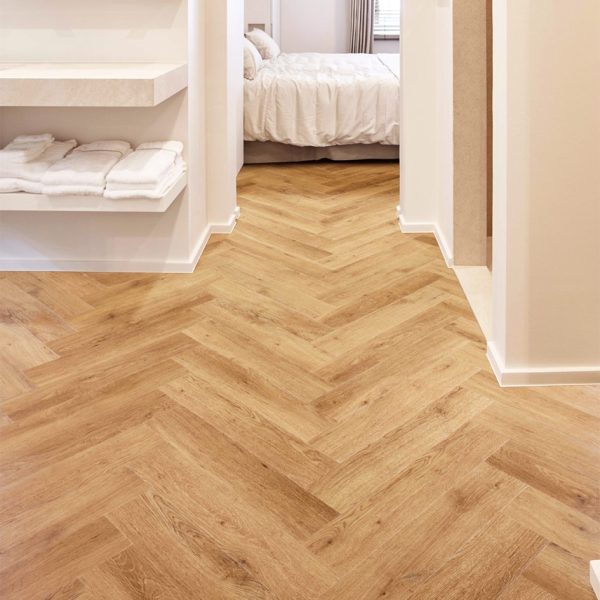
- Parquet styles such as herringbone
- Chevron (including left/right plank layouts where applicable)
Glue-down LVT is widely used in domestic interiors and many light commercial environments where a slim build-up, strong dimensional stability and a fully bonded finish are required.
Important note:
This is a general installation guide for indoor glue-down LVT. It is intended as a practical reference and does not replace the specific installation instructions provided by your flooring, adhesive, primer or levelling compound manufacturer. Always follow product-specific technical data where applicable.
Installing a Click LVT Floor Instead?
Glue-down LVT uses a fully bonded installation method with adhesive. If you are fitting a rigid core click system (SPC), the floor is installed as a floating system without glue.
Refer to the appropriate guide below:
- Click LVT (SPC) Straight Plank Installation Guide – for standard floating plank formats
- Click LVT (SPC) Herringbone Installation Guide – for rigid core click herringbone patterns
Click systems require different expansion allowances, underlay considerations and joint engagement methods. Always follow the guide specific to your product type.
Installation Guide Contents
- 1. Standards, Responsibility & Scope
- 2. Pre-Installation Checks
- 3. Acclimatisation
- 4. Subfloor Requirements
- 5. Moisture Testing & Damp Control
- 6. Subfloor Types & Preparation
- 7. Layout Planning & Dry Layout
- 8. Adhesive Selection
- 9. Installation Procedure (Step-by-Step)
- 10. Underfloor Heating Compatibility
- 11. Post-Installation Care
- 12. Perimeters & Edge Finishing
- 13. Maintenance & Ongoing Care
- 14. Common Installation Mistakes
- 15. Glue-Down LVT Installation FAQs
- 16. Helpful Videos & Visual Guides
1. Standards, Responsibility & Scope
Glue-down LVT flooring must be installed in line with UK Standard BS 8203 and current building regulations applicable at the time of installation.
It is the installer’s responsibility to assess the site conditions, subfloor suitability, and installation environment before work begins. This includes confirming that the subfloor, room conditions, and materials are appropriate for a fully bonded LVT installation.
Flooring should be visually checked prior to installation to ensure it is suitable for use.
Installation should only begin once all wet trades have been completed and site conditions are stable.
This guide applies to internal glue-down LVT (dryback) installations only and should be used alongside the instructions provided by the flooring, adhesive, and subfloor preparation product manufacturers.
2. Pre-Installation Checks
Careful checks before installation are critical. Most issues with glue-down LVT arise not from the product itself, but from unsuitable site conditions or missed checks at this stage.
Room Conditions
Before installation begins, the room must be fully enclosed and in its normal in-use condition.
- Room temperature must be maintained between 18°C and 27°C
- Temperature and humidity should be stable for at least 24 hours before installation, throughout installation, and for a minimum of 24 hours afterwards
- Heating or air-conditioning systems should be operational, or temporary systems used to maintain stable conditions
- All wet works must be complete and fully dry, including plastering, screeding, painting, and tiling
- No other trades should be working in the installation area during fitting
Unstable temperatures, excess moisture, or ongoing site activity can compromise adhesive performance and lead to movement, gapping, or bond failure.
Material Readiness
Before installation begins:
- Confirm the layout and orientation of the planks or tiles, particularly for directional wood-effect, tile, herringbone, or chevron designs
- Check the backing for directional arrows and install in accordance with manufacturer guidance
- Establish control or centre lines where required to maintain alignment, especially for herringbone or large areas
- Dry lay a small area if necessary to confirm the visual layout and setting-out
To achieve a balanced and natural appearance, mix planks or tiles from multiple boxes during installation.
Important: It is the installer’s responsibility to inspect the flooring prior to installation. Installation of the product confirms that the material has been checked and accepted.
3. Acclimatisation
Glue-down LVT must be allowed to stabilise to site conditions before installation. While LVT is a manufactured product, temperature stabilisation is still essential to ensure correct adhesive performance and dimensional stability during fitting.
- Allow flooring, adhesive, and subfloor to acclimatise for a minimum of 24 hours before installation
- If materials have been stored in cold conditions or outside the recommended temperature range, extend acclimatisation to 48 hours
- Store planks or tiles flat, fully supported, and unopened until ready for use
- Do not stack boxes excessively; follow manufacturer guidance and avoid stacking more than 5–10 boxes high
- Keep materials away from direct sunlight, heaters, radiators, and air vents during acclimatisation and installation
Throughout acclimatisation and installation, the room temperature must remain between 18°C and 27°C, with stable conditions maintained to avoid stressing the adhesive bond.
This process helps ensure a controlled installation environment and reduces the risk of movement or bonding issues once the floor is installed.
4. Subfloor Requirements
Glue-down LVT is only as good as the subfloor beneath it. Because the flooring is fully bonded, any weakness, unevenness, or contamination in the subfloor will telegraph straight through to the finished surface.
Before installation, the subfloor must be:
- Firm – structurally sound, with no movement or deflection
- Flat – level to the tolerances required for resilient flooring
- Smooth – no more than 3mm deviation over a 2 metre straight edge, in line with resilient flooring standards
- Dry – moisture levels within the limits set out in Section 5
- Clean – free from dust and loose debris
- Free from contamination – no paint, plaster, grease, oils, curing agents, or adhesive residues
Any cracks, holes, joints, or surface defects must be repaired and smoothed using compatible primers, levelling compounds, and repair materials before adhesive is applied.
If the subfloor does not meet these requirements, do not proceed with installation. Correct preparation at this stage is essential — the finished appearance and long-term performance of a glue-down LVT floor depend entirely on the quality of the base.
5. Moisture Testing & Damp Control
Moisture testing is mandatory for all glue-down LVT installations, regardless of whether the subfloor is new or existing. Excess moisture will compromise adhesive performance and can lead to bond failure.
Moisture must be measured in accordance with UK standards (BS 8203) using an appropriate test method for the subfloor type.
- Relative Humidity (RH) testing:
The subfloor must measure 75% RH or below - Calcium Carbide (CM) testing:
• Cement-based screeds: ≤ 2.0% CM
• Calcium sulphate / anhydrite screeds: ≤ 0.5% CM
If moisture readings exceed these limits, the subfloor must be treated with a suitable damp proof membrane (DPM) or moisture suppression system before installation proceeds. The system used must be compatible with the adhesive and levelling compounds applied above it.
Where required by the product manufacturer or site conditions, the pH of the concrete slab should also be checked and controlled within acceptable limits prior to applying primers, DPMs, or adhesives.
Installation must not proceed until moisture levels are confirmed to be within acceptable limits and the subfloor has been correctly treated.
6. Subfloor Types & Preparation
Correct preparation depends on the type of subfloor present. Each substrate must be assessed and prepared in line with UK standards and the requirements of the primers, levelling compounds, and adhesives being used.
Concrete & Sand/Cement Screeds
New and existing screeds
- Concrete and sand/cement screeds must be fully cured, dry, and structurally sound
- Drying time varies depending on thickness, construction, temperature, and ventilation
- New concrete will contain residual construction moisture and must always be moisture tested before installation
Mechanical preparation
- All concrete subfloors must be mechanically prepared to remove laitance, surface contamination, paint, plaster, curing agents, and old adhesive residues
- The surface must provide a suitable key for primers, levelling compounds, and adhesives
Power-floated concrete
- Power-floated surfaces are typically dense and low-porosity
- Mechanical abrasion (e.g. diamond grinding, shot blasting, or scarification) is required to remove surface laitance and improve adhesion
- Adhesives must not be applied directly to unprepared power-floated concrete
Levelling compounds
- Most concrete subfloors will require a compatible levelling or smoothing compound to achieve the flatness required for glue-down LVT
- Follow the compound manufacturer’s guidance on priming, thickness, and curing times
Calcium Sulphate / Anhydrite Screeds
Calcium sulphate (anhydrite) screeds can be difficult to identify and are often mistaken for cement-based screeds.
- Confirm screed type with the builder or screed manufacturer before proceeding
- The surface laitance must be fully abraded and removed
- The screed must be dry to the required moisture limits before installation
- Use only primers, levelling compounds, and adhesives approved for use with calcium sulphate substrates
Failure to correctly identify and prepare anhydrite screeds is a common cause of adhesive failure.
Timber Subfloors
Timber subfloors must be stable and free from movement before glue-down LVT can be installed.
Floorboards
- Secure all loose boards and replace any damaged sections
- Sand or level uneven areas where required
- Overlay with a minimum 5.5mm flooring-grade plywood
Chipboard, OSB, MDF
- Glue-down LVT must not be bonded directly to these substrates
- A minimum 5.5mm flooring-grade plywood overlay is required
Plywood overlay requirements
- Plywood must be flooring grade and suitable for resilient flooring
- Fix at 100mm centres around the perimeter and 150mm centres across the field
- Fixings must be flush with the surface
- Stagger joints and avoid aligning plywood joints with those in the subfloor
- Skim or patch all joints and fixings, or apply a suitable primer and levelling compound
All timber-based subfloors must be rigid, well-ventilated, and free from excessive deflection. Any movement must be addressed before installation.
Existing Floor Coverings
Tiles, terrazzo, quarry tiles
- Check for dampness before proceeding
- Remove any loose or damaged tiles
- Mechanically clean and abrade the surface to remove sealers, waxes, and contamination
- Fill grout lines and apply a compatible primer and levelling compound to prevent show-through
Existing resilient flooring
- Existing resilient floors should be removed along with all adhesive residues
- Prepare the exposed subfloor in line with its substrate type
Specialist Subfloors
Asphalt
- Glue-down LVT must not be bonded directly to asphalt
- Apply a suitable smoothing compound in line with manufacturer guidance before installation
Metal
- Surfaces must be cleaned, degreased, and mechanically abraded to remove corrosion and provide a surface key
- Where required, apply a suitable primer and levelling compound before installing LVT
- Use adhesives appropriate for non-absorbent substrates
Raised access floors
- Glue-down LVT must not be installed directly onto raised access panels
- Panels must be overlaid with a suitable plywood system before installation
Asbestos
- Some older floor coverings and adhesives may contain asbestos
- Where suspected, materials must be tested and removed by a licensed professional before any preparation or installation work is carried out
7. Layout Planning & Dry Layout
Careful layout planning is essential with glue-down LVT. Once adhesive is applied, adjustment time is limited, so setting out must be confirmed before installation begins.
- Establish the primary centre line(s) or control line(s) of the room to create a balanced layout and minimise narrow perimeter cuts.
- Where installing planks, assess how the first and final rows will fall — particularly at doorways, transitions and prominent walls.
- Calculate where the first full-width plank will sit once perimeter cuts are allowed for. Mark a straight reference line at this position — this will typically form the starting line from which the first row is installed.
- Dry lay a section of planks or tiles to confirm alignment, pattern flow and perimeter finishes.
- Check printed grain orientation or directional arrows on the reverse of the product and maintain consistency throughout the installation.
- Plan the stagger of end joints where applicable, in accordance with the product design and pattern requirements.
Dry laying allows potential layout issues to be identified early, ensuring adjustments can be made before adhesive is applied.
Herringbone & Chevron Layouts
Parquet-style glue-down LVT requires additional planning and accurate setting out.
For herringbone installations, the centre line acts as a starting spine, not simply a visual midpoint. Before committing to this line, check the squareness of the room, as few rooms are perfectly 90°. Adjusting the starting spine slightly can help balance perimeter cuts and prevent the pattern drifting as the installation progresses.
- Separate left-hand and right-hand planks before installation (where applicable)
- Set out the pattern from a clearly defined centre line or datum point
- Maintain consistent alignment as the pattern develops, regularly checking for square to prevent drift across the floor
- Dry lay perimeter cuts in advance to confirm final alignment and minimise small or awkward pieces
Correct planning at this stage ensures the pattern remains balanced, square, and visually consistent across the entire floor area.
8. Adhesive Selection
Correct adhesive selection is critical for glue-down LVT. The adhesive must be suitable for both the flooring and the site conditions. Using the wrong adhesive is one of the most common causes of installation failure.
The adhesive used must be compatible with:
- The subfloor type (absorbent vs non-absorbent, timber vs mineral)
- Site temperature and environmental stability
- Underfloor heating systems, where present
- Areas exposed to direct sunlight or elevated surface temperatures
- Any damp proof membrane (DPM), primer, or smoothing compound within the subfloor build-up
Different site conditions require different adhesive technologies:
- Water-based acrylic adhesives
Typically suitable for stable internal environments with controlled temperatures and no excessive heat exposure. - Moisture-curing adhesives
Used where improved moisture resistance, enhanced bond strength, or suitability for certain non-absorbent substrates is required.
- Two-part (chemical cure) adhesives
Specified for more demanding conditions, including higher thermal stress, areas exposed to greater temperature variation, or where increased resistance to moisture and movement is necessary.
Adhesives must be applied using the trowel type and notch size specified by the adhesive manufacturer. Spread only the amount that can be covered within the stated open time.
Where a pressure-sensitive adhesive is specified, it must be allowed to reach the correct tack stage before laying. Interchanging adhesive types without manufacturer approval can invalidate warranties.
During installation, periodically lift a plank or tile to confirm full adhesive transfer to the backing.
Always follow the adhesive manufacturer’s instructions precisely, including guidance on priming, tack time, open time, rolling, curing periods, and environmental conditions. Failure to do so can result in poor bond strength, movement, edge lift, or long-term performance issues.
9. Installation Procedure (Step-by-Step)
Once preparation and layout are complete, installation should be carried out in a controlled, methodical manner. Work steadily and avoid rushing — adhesive working times and correct rolling are critical to a successful bond.
Adhesive working times
Adhesive instructions may refer to both tack time and open time. These are not the same:
- Tack time: The waiting period after spreading the adhesive before placing the flooring, where specified.
- Open time: The total working time available to lay the flooring before the adhesive begins to set.
Some adhesives require immediate placement, while others perform best after a short tack period. Always follow the adhesive manufacturer’s instructions.
Spread the adhesive correctly
Apply adhesive evenly using the trowel type and notch size specified by the adhesive manufacturer (commonly A1 or A2, depending on the adhesive and subfloor).
Hold the trowel at the correct angle to maintain consistent ridge height. Spread only the quantity that can be covered within the stated open time.
Where a pressure-sensitive adhesive is specified, allow it to reach the correct tack stage before laying. For wet-set adhesives, install within the designated working window.
Lay within the adhesive’s working time
Install planks or tiles in line with the planned layout and orientation, ensuring full and even contact with the adhesive bed as each piece is placed.
Do not force pieces into position or slide excessively, as this can displace adhesive ridges. Periodically lift a plank or tile to confirm full adhesive transfer to the backing.
Roll as you progress
As installation advances, use a hand roller to press the flooring firmly into the adhesive. Pay particular attention to edges, joints, and perimeter areas to ensure ridges are collapsed and proper transfer is achieved.
Complete a full cross-roll
Once the installed area is complete, roll the floor in both directions (lengthwise and widthwise) using a heavy roller — typically 45–68kg — where access allows.
In smaller rooms or restricted spaces, use a hand roller to achieve equivalent pressure. Full rolling is essential to collapse trowel ridges and achieve long-term bond strength.
Remove adhesive residue immediately
Clean off any adhesive contamination straight away in accordance with the adhesive manufacturer’s cleaning guidance. Dried adhesive can permanently mark the surface and is significantly more difficult to remove.
Protect the floor and restrict traffic
Prevent foot traffic for a minimum of 24 hours to allow the adhesive to cure. Avoid placing heavy furniture, point loads, or rolling loads during this period.
If other trades require access, protect the surface using breathable floor protection materials.
Stable site conditions must be maintained during curing to ensure proper adhesive performance and long-term stability.
10. Underfloor Heating Compatibility
Glue-down LVT can be used successfully with underfloor heating, provided the system is correctly specified, commissioned, and controlled. Temperature management is critical to protect the adhesive bond and ensure long-term performance.
Before installation, the underfloor heating system must be fully commissioned and confirmed to be operating correctly, with no leaks, faults, or cold spots.
The following rules must be followed:
- The maximum temperature at the adhesive interface must not exceed 27°C
- Underfloor heating must be switched off:
- 48 hours before installation
- During installation
- For 48 hours after installation
After installation, the system must be brought back into use gradually:
- Increase the temperature by no more than 2°C per day
- Do not exceed the maximum surface or adhesive interface temperature at any time
Care must be taken to avoid localised hot spots. Items such as thick rugs, beanbags, or furniture without airflow underneath can trap heat and cause excessive temperatures in isolated areas. This can lead to adhesive softening, discolouration, or floor damage.
Where large uninterrupted areas are installed, follow the flooring manufacturer’s guidance regarding movement allowances in extreme environments.
For full system requirements, commissioning steps, and detailed guidance, refer to our dedicated Glue-Down LVT with Underfloor Heating Guide, which should always be read alongside this installation guide.
11. Post-Installation Care
Once installation is complete, the floor should be protected to allow the adhesive to cure fully.
- If other trades need access, protect the floor surface using suitable breathable coverings
- Avoid placing heavy furniture, point loads, or rolling loads for at least 24 hours
- Do not wet clean or wash the floor for a minimum of 24 hours after installation
Early loading or cleaning can disrupt the adhesive bond and affect the long-term performance of the floor. Stable room conditions should be maintained during this initial curing period.
12. Perimeters & Edge Finishing
Glue-down LVT is a fully bonded system and does not require a perimeter expansion gap in the same way as floating floors.
- Flooring should be neatly cut tight to walls, skirtings, and fixed objects
- Perimeter expansion gaps are not required unless specifically stated by the product manufacturer
- Silicone sealant is not normally required for glue-down LVT installations
If silicone is specified or requested, it should only be applied after the adhesive has fully cured. Applying silicone too early can cause issues, as curing sealant can contract and pull the perimeter tiles or planks, leading to minor gapping or edge lift.
Where used, silicone should be applied sparingly and neatly, taking into account natural building movement and settlement over time.
13. Maintenance & Ongoing Care
Correct ongoing care will help maintain the appearance and performance of glue-down LVT over time.
- Use entrance mats at external doorways to reduce grit and moisture being tracked onto the floor
- Fit protective pads to the legs of furniture and avoid dragging heavy items across the surface
- Clean regularly using pH-neutral cleaning products specifically designed for LVT or resilient flooring
- Do not allow standing water to remain on the floor, as this can increase slip risk and may affect the adhesive bond over time
For detailed cleaning routines, product recommendations, and long-term care advice, refer to our Luxury Vinyl (LVT) Flooring Care & Maintenance Guide, which should be followed once the floor is in use.
14. Common Installation Mistakes
Most issues with glue-down LVT are avoidable. The points below highlight the most common causes of installation failure.
- Skipping moisture testing
Installing without confirming moisture levels can lead to adhesive breakdown and loss of bond. - Installing over poorly prepared subfloors
Uneven, contaminated, or unstable subfloors will telegraph through and compromise the finished floor. - Using the wrong adhesive
Adhesives must match the subfloor type, temperature conditions, and any underfloor heating present. - Underfloor heating not commissioned or incorrectly controlled
UFH systems must be tested, switched off during installation, and recommissioned gradually.
- Insufficient rolling
Failing to roll the floor properly can leave adhesive ridges uncompressed, resulting in poor transfer and weak bonding. - Installing outside adhesive open time
Allowing adhesive to skin over before placement can result in poor transfer and bond failure.
Avoiding these issues at the installation stage significantly improves long-term performance and appearance.
15. Glue-Down LVT Installation FAQs
The following FAQs address the most common installation-critical questions we receive for glue-down LVT.
They focus on subfloor suitability, moisture control, adhesives, and environmental conditions — the areas most likely to affect long-term performance if handled incorrectly.
Yes — provided the system is correctly commissioned and properly temperature controlled.
The underfloor heating system should be fully tested and operational prior to installation. It must then be switched off 48 hours before fitting, remain off during installation, and stay off for 48 hours afterwards.
The adhesive interface temperature must not exceed 27°C at any time. Once the floor has cured, heating should be reintroduced gradually, increasing by no more than 2°C per day. Rapid temperature changes are a common cause of adhesive softening and bond failure.
Moisture testing is essential for all installations. The subfloor must comply with BS 8203 limits:
- Relative Humidity (RH): 75% RH or below
- Calcium Carbide (CM) testing:
- Cement-based screeds: ≤ 2.0% CM
- Calcium sulphate / anhydrite screeds: ≤ 0.5% CM
If readings exceed these levels, a suitable damp proof membrane (DPM) or moisture suppression system must be installed before priming, smoothing or applying adhesive.
No. Glue-down LVT is a fully bonded system and does not require a perimeter expansion gap in standard installations.
The flooring should be neatly cut to walls, skirtings and fixed objects, unless the manufacturer specifies otherwise. This differs from floating click systems, which do require expansion space.
No. It must not be bonded directly to floorboards, chipboard, OSB or MDF.
Timber subfloors need to be stabilised and overlaid with a minimum 5.5mm flooring-grade plywood, fixed at the correct centres and prepared to provide a smooth, rigid base. Any movement in the subfloor will transfer directly into the finished floor.
Yes — rolling is critical.
It ensures full adhesive transfer, compresses trowel ridges and achieves the bond strength required for long-term performance.
The floor should be rolled progressively during installation, paying close attention to edges and joints, and then rolled again after completion using a heavy roller (where access allows) or a hand roller in smaller areas. Insufficient rolling is a frequent cause of edge lift.
Yes, provided the tiles are sound, secure and free from movement.
The surface must be thoroughly cleaned and mechanically prepared. Grout lines should be filled, and a compatible primer and levelling compound applied to prevent telegraphing through the finished floor.
Any loose, cracked or contaminated tiles should be removed and the substrate prepared correctly before installation continues.
Foot traffic should be avoided for at least 24 hours to allow the adhesive to cure.
Heavy furniture, rolling loads and wet cleaning should also be delayed during this period. Once fully cured, the floor can be cleaned using a pH-neutral product designed for LVT. Premature loading or washing can weaken the adhesive bond.
In most residential installations, yes. Glue-down (dryback) LVT is fully bonded to the subfloor and is dimensionally stable under normal internal conditions. Kitchen units and islands can typically be installed directly on top once the adhesive has fully cured.
However, installation practices can vary depending on room size, underfloor heating, and manufacturer requirements. Always follow the flooring and adhesive manufacturer’s guidance before fixing heavy or permanent cabinetry.
16. Helpful Videos & Visual Guides
This guide is designed to be followed step by step, but glue-down LVT is one of those installs where a short visual reference can prevent expensive mistakes — especially around moisture control, smoothing, adhesive timing, and rolling.
The videos below are intended as visual support only. Always prioritise:
- the flooring manufacturer’s installation instructions
- the adhesive/primer/levelling compound manufacturer guidance
- the moisture limits and preparation rules set out earlier in this guide (BS 8203)
Glue-Down LVT Installation – Subfloor Preparation & Herringbone Fitting
Subfloor preparation is one of the most critical stages of any successful glue-down LVT installation. Even the highest-quality flooring will only perform as well as the surface beneath it.
This in-depth installation video walks through the full preparation and fitting process over an anhydrite screed, demonstrating industry best practice from start to finish.
The video covers:
- Identification and mechanical preparation of anhydrite screeds
- Laitance removal
- Moisture testing procedures
- Priming the subfloor
- Application of self-levelling and smoothing compounds
- Feather finishing where required
- Adhesive selection and correct tack time
- Herringbone LVT installation techniques
- Rolling and finishing procedures
- Aftercare guidance
Particular attention is given to ensuring the subfloor is flat, dry and properly prepared before installation begins — a key factor in achieving long-term performance, especially in higher temperature environments.
This video demonstrates the level of preparation required to achieve a professional, stable and durable glue-down LVT installation.
Glue-Down LVT Plank Installation – Timber Subfloor Guide
This step-by-step installation video demonstrates how to fit glue-down LVT planks over an already installed plywood subfloor.
While subfloor preparation remains essential, this guide focuses specifically on installation over porous timber bases, covering the correct priming process and layout planning required for a stable and professional finish.
The video covers:
- Priming a porous plywood subfloor
- Planning the layout before installation
- Establishing a straight starting line
- Marking and chalking guide lines
- Applying adhesive correctly
- Laying rows accurately and maintaining alignment
- Achieving a clean, seamless finish
Flexible glue-down vinyl flooring provides a secure, bonded installation method that creates a solid feel underfoot with minimal movement. When installed correctly over a properly prepared subfloor, it delivers long-term durability and a clean, precise appearance.
This guide highlights the importance of careful set-out and adhesive control — two key factors in achieving a professional result.
Glue-down LVT delivers a stable, long-lasting and highly precise finish when installed correctly. The key to success lies in careful subfloor preparation, accurate set-out and correct adhesive control. Taking the time to follow best-practice installation methods will ensure the floor performs as intended for many years.
If you are ever unsure about subfloor condition or installation requirements, seeking advice from a qualified flooring professional is always recommended.
Ready to Choose Your Glue-Down LVT?
About Floor Warehouse
Floor Warehouse is a UK-based flooring specialist with over 15 years of combined industry experience in sourcing, selling, and advising on wood, laminate, SPC, and LVT flooring. Our expert advice is written to help homeowners, designers, and trade professionals make informed flooring decisions — from installation and maintenance to underfloor heating compatibility, sustainability, and long-term performance. All guidance is based on real-world product knowledge, manufacturer standards, and common questions we see every day from customers across the UK.
View all posts by Floor Warehouse